

When it comes to skin routines, I am one of those people who doesn’t easily switch cosmetic brands. I have very sensitive, dry skin, so I don’t like experimenting.
However, as with many other consumers, price and availability play a key role in my beauty habits. That’s why I have “backup” brands I turn to when needed.
Industry data suggest that 40% of consumers will do the same and choose another brand when their brand of choice is unavailable at their usual store, according to 2023 data by Aytm: Secrets of Skincare & Brand Switching.
The same report indicates that more than 60% of shoppers are at least somewhat likely to switch brands, motivated by price, variety, personal needs, and preferences.
This is just one of several challenges both direct-to-consumer (DTC) brands and beauty retailers have faced over the last few years.
Key cosmetic industry challenges:
- Market saturation: 54% of beauty executives identify “uncertain consumer spending” and market saturation as the greatest risks to growth in 2026, according to THG Commerce’s 2026 Beauty Report.
- Customer behavior shift: Consumers are moving away from trends and are increasingly looking for “clinical confidence,” according to Euromonitor: Top Trends 2025/2026.
- Trend lifespan: The average lifespan of a viral beauty trend on social media has shrunk to just 3 to 4 weeks, making it hard for traditional brands to keep up, reveals THG Commerce’s 2026 Beauty Report.
The latest beauty brand that has to change its operating model as it faces some of these challenges is Glossier.
Glossier to close nine out of 12 stores and trim its product portfolio
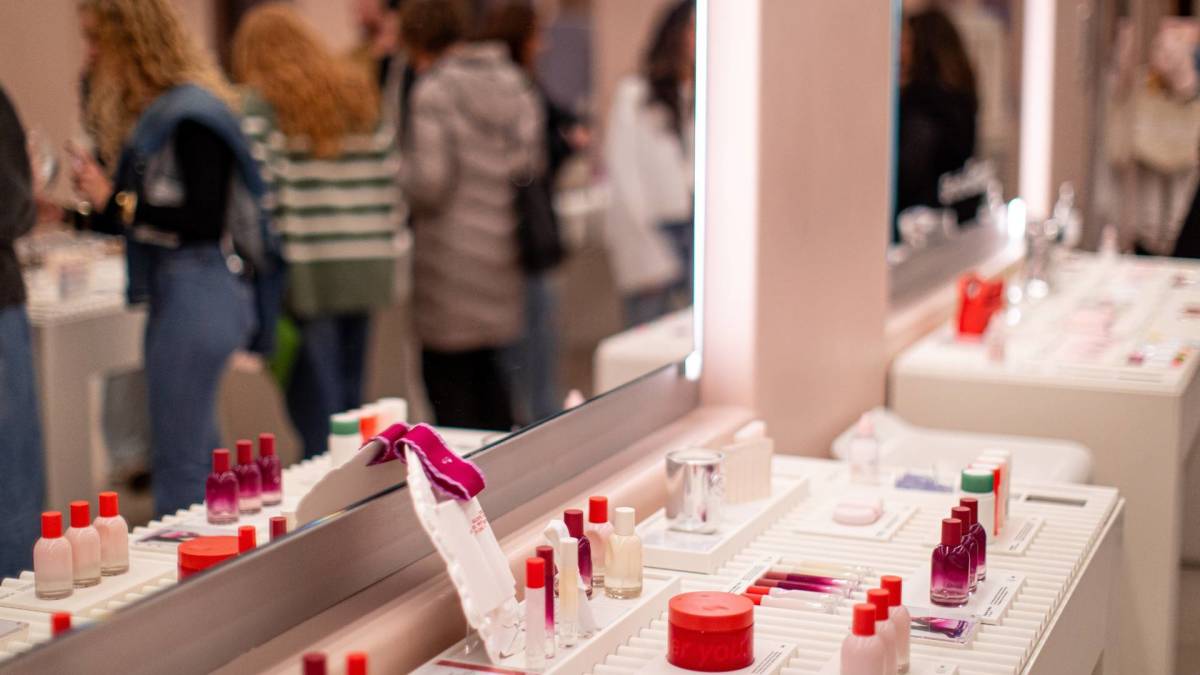
Beauty brand Glossier recently confirmed it will close nine of its 12 stores over the next two-and-a-half years, leaving just three flagships in New York, Los Angeles, and London.
Colin Walsh, the company’s chief executive since October 2025, confirmed the new strategy to The Business of Fashion, explaining that he is looking to start over.
Over the last few years, the company struggled with changes in customer behavior. Its golden era was under founder Emily Weiss, when the brand provided exactly what Millennials wanted. Then Gen Z changed the demands, and Weiss withdrew from her position in 2022.
When Kyle Leahy took over, she tried to transform the company, teaming up with Sephora for shelf space and expanding into new beauty products. While results were mixed, with Glossier having success with scents such as You Doux, it was always running behind competition such as Rhode (Hailey Bieber’s brand) and Merit, according to the Business of Fashion.
Now Walsh, former CEO of prestige hair brand Ouai, Procter & Gamble’s specialty beauty arm, aims to make a more radical change, starting with store closures and trimming Glossier’s product catalog.
bluestork/Shutterstock.com
Why Glossier is closing stores: the “playgrounds” transformation
The goal behind Walsh’s new strategy is to return the company to its original positioning and provide quality over quantity. Walsh told the outlet that the closures and other changes are needed to concentrate on a “true expression of where this brand has been and where it needs to go.”
The CEO explained that the majority of Glossier locations were more of a headache than a benefit. He decided it would be better to let big retailers like Sephora and Space NK handle Glossier’s sales.
“We can get caught being operationally heavy with 12 locations … leases, managing all the infrastructure distracts you,” Walsh said.
The remaining three stores are set to be transformed into what Walsh calls “playgrounds” that would host events, offer programming, and provide a space to test new ideas. These stores — one in New York’s SoHo neighborhood, the other on Melrose Place in Los Angeles, and the third in Covent Garden in London — were chosen to remain as they drive 55% of store revenue and 60% of new customers.
“You can expect more surprising programming and innovative experiential moments in our flagship stores that are always rooted in our community-driven storytelling, which is at the core of our brand,” a Glossier spokesperson told Fast Company.
Why is Glossier trimming its product lineup?
Glossier launched in October 2014 with only four items.
“Over the past four years running Into The Gloss, I saw the need for a beauty brand that speaks to its consumers directly, offering them a chance to engage beyond the traditional touch points of purchase, use and mass marketing. That’s what we’ve created with Glossier—a beauty brand that we want to be friends with,” then-CEO Weiss stated at the time.
More Retail:
- Walmart closes stores for weeks to test new perks for shoppers
- Target launches another generous deal to win back shoppers’ trust
- 91-year-old grocery chain closes another store in a key market
Over the years it grew its businesses, but also shifted away from its original concept. By 2023, the brand started releasing products almost on a monthly basis. The company entered the race started by its competition, pivoting from its initial track.
And while some of its new products, such as the extension of the You fragrance, were successful, “many felt incongruent with the Glossier ethos,” points out Priya Rao, executive editor at The Business of Beauty at The Business of Fashion.
“We became a product company across a lot of categories, versus this curated brand focused deeply on their customers’ needs in life,” Walsh said.
Now, Walsh plans to focus on the brand’s core products, such as Cloud Paint blush and Boy Brow eyebrow gel. However, it will start by doubling down on fragrances, as the company has seen double-digit growth in this sector.
“More spotlight will be shone on the brand’s hero products, as seen with its Glossier You fragrance and “You Smell Good” campaign that launched last month,” a Glossier spokesperson told Fast Company.
Glossier is not alone in its struggles
Glossier is not the only DTC brand or traditional beauty retailer to deal with industry challenges. Over the last few years, many DTC brands born on the internet began opening physical stores, only to find out that rising rent, harsh competition, and economic headwinds are making it nearly impossible to remain profitable.
For example, earlier this year, Pat McGrath Labs, the legendary DTC brand founded by makeup artist Pat McGrath, filed for Chapter 11 bankruptcy, reporting assets and liabilities in the range of $100 million to $500 million, according to prior reporting by TheStreet.
Another example is Gwen Stefani’s DTC brand GXVE Beauty. It quietly went dark, taking its website offline and exiting retail partnerships, reported TheStreet’s Fernanda Tronco.
Beauty brand closures & bankruptcies (2024-2026):
- The Body Shop US: In 2024, The Body Shop US closed all U.S. stores following a sudden Chapter 7 liquidation, according toRetail TouchPoints.
- Forma Brands/Morphe: In 2024, it filed for Chapter 11 and shuttered all standalone U.S. stores to pivot toward wholesale and international markets, reported Financier Worldwide.
- Cover FX & Mally Beauty: Parent company AS Beauty Group permanently closed both labels due to global trade challenges, according to previous reporting by TheStreet.
- Good Light Cosmetics: The gender-inclusive K-beauty brand confirmed a total closure set for April 2026 due to high competition, according to The Fashion Law.
- Flower Beauty: In September 2025, Drew Barrymore’s mass-market cosmetics line shuttered permanently after a 13-year retail run, reported Beauty Independent.
Glossier consumers react to closures and strategy shift
On platforms like Reddit, early reaction to Glossier’s decision to close most of its stores has been mixed. While some users expressed disappointment over the loss of physical locations, others said the move was “not surprising,” pointing to what they see as a gradual shift away from the brand’s original identity.
Some users pointed out years of changes in product strategy, pricing, and brand direction.
“As to the products, I think they actually have too many but not good enough. The first products they had, like haloscope, gen G, brow boy, stretch concealer, milky jelly were unique at the time in terms of formula and effect. They no longer have products that would feel unique and had a strong style,” wrote user konstantynopolitanka.
The discussion reflects broader concerns that Glossier has lost its differentiation in an increasingly saturated market, something the new CEO also confirmed.
And while many users expressed disappointment over the closings, some are hopeful that this is actually the right move for the company.
Related: Walmart quietly changes how it prices items